

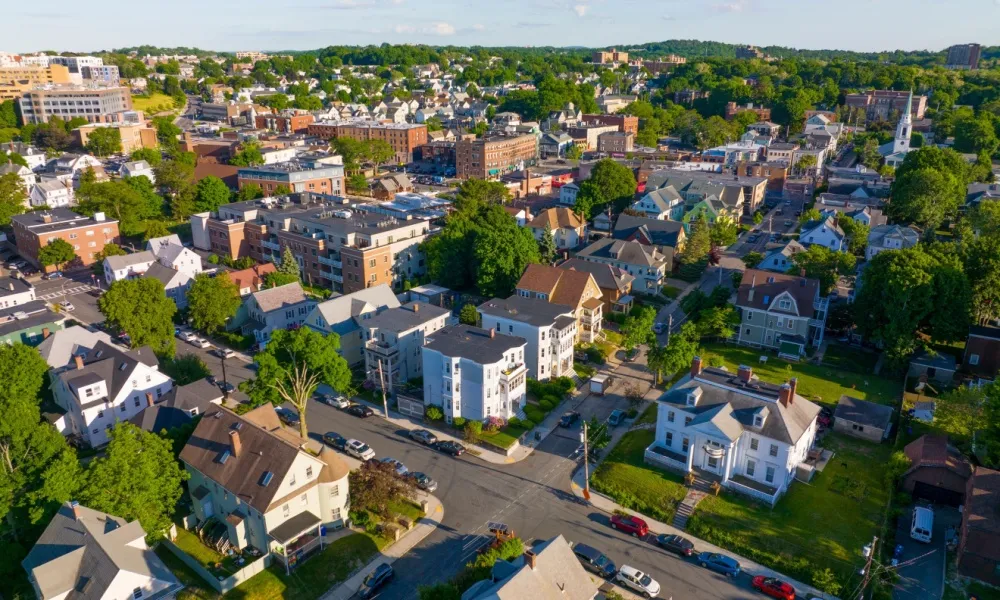
Walk through the village centers of Newton, Watertown, or Wellesley – quiet suburbs just west of Boston – on a weekday afternoon and the signs are hard to miss: a Wellesley café that can’t keep staff, a storefront on Needham Street vacant for months, a Newton Centre restaurant that’s cut its hours because workers can’t afford to live nearby. Most residents don’t think of these as symptoms of a housing problem. But they are.
The same person organizing against an apartment building near the train station – worried about traffic, parking, the loss of neighborhood character – is often the same person lamenting that their favorite bookshop closed or that there’s nowhere decent to eat on a Tuesday night. The connection rarely registers. But it’s reshaping the economic fabric of Boston’s inner western suburbs in ways that are becoming harder to ignore.
The contradiction runs deeper than hypocrisy. It’s rooted in a decades-old assumption that density is an inherently corrupting force – something that belongs in cities, not here. That assumption has long organized suburban planning. And it may be destroying the very things it was meant to protect.
A Misread Threat
Max Woolf, Public Policy and Government Affairs Manager at the Charles River Regional Chamber, argues that suburban opposition to multifamily housing is built on a misreading of what density actually does to a community. Across the five towns the Chamber covers – Brookline, Watertown, Newton, Needham, and Wellesley – the objections follow a familiar script: new apartments will overwhelm school systems, clog already-strained roads, eliminate parking, and attract a different kind of resident than the one who made the neighborhood desirable in the first place. Beneath all of it runs the same fear – that adding density will turn a quiet suburb into something unrecognizable.
Woolf’s argument is not that density is harmless or costless, but that communities resisting it are misidentifying the threat. The real risk, in his view, is not that new housing will alter a suburb’s character. It’s that refusing to add housing will hollow out the economic base that gives the suburb its character in the first place. “A lot of our suburban communities say we don’t want to be Boston, but that misses the point,” Woolf says. “We’re never going to be Boston out here.”
Keeping Village Centers Alive
The village center – a distinctly New England form of small-scale downtown – is the clearest example of where the economics of density play out in ways that residents rarely connect to housing policy. These clusters of independent shops, restaurants, and services are widely valued in the communities the Chamber represents. They are also, Woolf argues, directly dependent on the residential density that many of those same communities are working to limit.
The logic is straightforward: a restaurant needs enough nearby residents to generate consistent foot traffic. A retailer needs a workforce that can afford to live close enough to show up reliably. When housing supply is constrained, and costs rise, both conditions erode. Workers commute from farther away or leave the region entirely, and the customer base for local businesses thins.
Woolf argues that communities treating their housing supply as a fixed asset are slowly defunding the commercial activity they most want to preserve. It’s a mistake, he says, to think that the status quo is going to help any of these businesses or sustain the local economy. “We need more housing.”
Embracing Density
Watertown offers the clearest regional example of a community that connected residential and commercial growth deliberately and has seen tangible results. The city has been at the center of greater Boston’s biotech expansion, and Woolf says the town made a conscious decision to pair that commercial development with residential supply. This has included aggressively rezoning its downtown, allowing qualifying projects to proceed without a public approval process, and actively inviting development rather than managing it defensively.
That posture puts Watertown ahead of a curve that Massachusetts is now imposing on Watertown and its neighbors. Under the MBTA Communities Act, cities and towns with subway or commuter rail access are required to zone for multifamily housing near transit stations, removing, at the state level, the kind of local discretion that has long allowed resistant communities to stall or block new development. For towns that have spent decades treating their housing supply as fixed, the law represents a significant shift in who gets to make that decision.
Woolf says Watertown’s early moves were designed to reduce developer uncertainty and let qualifying projects proceed more smoothly, the same logic the state is now applying region-wide. The result, in his assessment, is a community that has grown more economically vibrant without losing its identity. This stands as a direct counter to the fear that density leads inevitably to character loss. “Watertown’s done a great job of pairing their commercial development with residential development, giving their workers a place to stay, and really embracing growth,” he says.
The Economic Case for Housing
Beyond individual projects, the Charles River Regional Chamber has built its housing advocacy around the argument that residential growth and business vitality are inseparable, and that the business community has both a stake in housing outcomes and a credible voice in local approval processes.
Woolf says the Chamber’s approach involves bringing employers, restaurant owners, and retailers directly into public hearings, where their testimony about workforce access and customer foot traffic can shift the political conversation in ways that developer presentations often cannot. A restaurant owner explaining how a nearby housing project would shorten employee commutes and bring in more customers carries weight with planning boards that are skeptical of housing advocates but responsive to local employers. “That’s something that leadership in a city wants to hear,” Woolf says.
Whether that approach can overcome the structural resistance embedded in suburban governance remains uncertain. Woolf describes multifamily rezoning in single-family neighborhoods as “the next frontier” and acknowledges it is the hardest ground to gain.
But as more communities confront the economic consequences of constrained housing supply, the argument that density threatens community character may become harder to sustain in the face of the visible decline of the village centers those communities are trying to protect. The question is whether the business case can move faster than the erosion it is trying to prevent.
About the Expert: Max Woolf is the Public Policy and Government Affairs Manager at the Charles River Regional Chamber, representing Brookline, Watertown, Newton, Needham, and Wellesley in Greater Boston’s inner western suburbs. His work focuses on housing policy, zoning reform, and economic development advocacy across the region.
This article is intended for informational purposes only and does not constitute legal, financial, or investment advice. The views and opinions expressed herein reflect those of the individuals quoted and do not represent an endorsement of any company, product, or service mentioned. Readers should conduct their own due diligence and consult qualified professionals before making any investment decisions.