
A regulatory change that allows developers to build up to four times as much square footage is unlocking mixed-use projects in a city where meaningful development had stalled for decades.
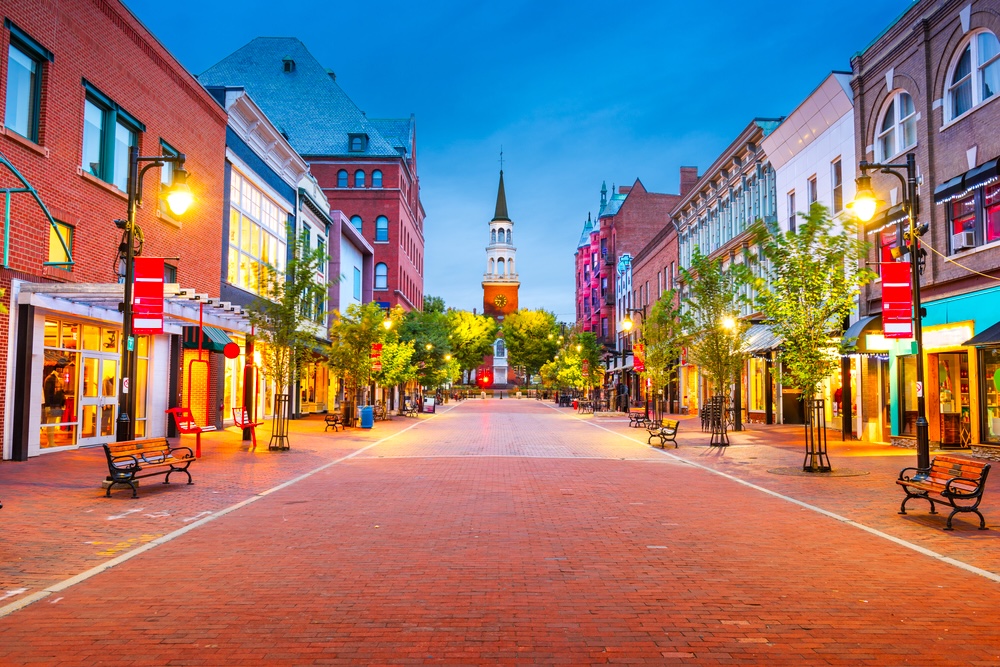
Burlington, Vermont’s recent overhaul of its floor-area ratio zoning rules – allowing construction at a 4:1 ratio relative to lot size in designated districts – is creating tangible investment opportunities in a market that had seen almost no significant development activity for years. The change is arriving at the same moment that a post-COVID commercial vacancy problem is creating a secondary opportunity: former office and retail space converted to housing has left a gap in the commercial market that new mixed-use development is beginning to fill. Isaiah Donaldson, founder and lead realtor at IDENTITY Real Estate Group, argues that Burlington’s regulatory environment may represent one of the more underappreciated entry points in the Northeast.
Decades of Stagnation
Vermont’s Act 250, a land-use law enacted in 1970, imposed some of the most restrictive development permitting requirements in the country. The practical effect, according to Donaldson, was that Burlington went decades with minimal new construction – not because demand was absent, but because the regulatory cost and complexity of building made most projects economically unviable.
“For so long, for decades, really nothing happened on the big development side of things,” Donaldson says. “You’d see one or two things pop up every few years, but it wasn’t like this big boom.”
Act 250 has begun to loosen in the post-COVID period, and Burlington has layered its own zoning reforms on top of that. The FAR rule change – finalized approximately two months before this interview in May 2026 – allows developers in designated Burlington districts to build up to four times the lot’s square footage. Donaldson says projects that were previously penciled out as financially unworkable are now viable, and local developers are beginning to act on that.
A New Vacancy
The development opportunity in Burlington isn’t limited to ground-up construction. An unintended consequence of the post-COVID shift to remote work is now creating demand for a different type of space entirely.
During the pandemic and its aftermath, many Burlington building owners converted underutilized commercial and office space into residential units – a logical response to strong housing demand and weak office demand. That conversion wave has now created a shortage of the very commercial space it eliminated. Retail storefronts, office suites, and service-oriented commercial units are becoming harder to find as the buildings that once housed them have been permanently repurposed.
“A lot of building owners converted those commercial spaces to housing, to apartments, and now we’re starting to see more of a need for the office spaces or retail storefronts,” Donaldson says. “Those buildings were shifted into housing, and they’re not going to get shifted back.”
Donaldson describes this as a meaningful opportunity for investors willing to develop or reposition commercial space in Burlington’s core neighborhoods. The old north end, in particular, is seeing activity. One investor he works with recently acquired a property that has operated as a single commercial unit since 1950 and is now planning to subdivide it into 12 separate commercial spaces – adding storefronts and wellness-oriented tenants to a neighborhood with limited existing supply of that type.
Affordability Is Mandatory
While Burlington’s zoning reforms unlock density, they also attach affordability requirements to projects that exceed certain unit thresholds. Developers building above a specified number of units must include a percentage of affordable units in the project, a requirement that is shaping how new construction is structured across the city.
This requirement is producing mixed-income buildings in areas that previously had little new construction of any kind. Downtown Burlington is seeing luxury condos and apartments developed alongside income-restricted units within the same projects. This model, Donaldson says, is becoming more common as developers learn to underwrite the affordability mandate into their pro formas.
“Depending on how many units you build, you have to have a certain percent of affordable units as well,” Donaldson says, “and we’re seeing those start to really tick up.”
For investors evaluating Burlington, this means that development returns need to account for the affordable-unit requirement. But it also means that projects meeting that threshold benefit from a regulatory environment that is, by design, supportive of density.
Investors Take Note
Donaldson’s firm has been working directly with investors pursuing the opportunities created by Burlington’s zoning changes, and he sees the current moment as one of the more compelling entry points the market has offered in decades.
The old North End commercial conversion is one active example – a property that operated as a single commercial unit since 1950, now being redeveloped into 12 separate storefronts and wellness spaces to meet rising commercial demand in an underserved neighborhood. But Donaldson’s broader thesis extends well beyond individual transactions. He points to the convergence of institutional anchors – UVM, UVM Medical Center, and Beta Technologies, which recently went public – as structural demand drivers that underpin the investment case regardless of where in Burlington a developer chooses to deploy capital.
“No matter if you’re all the way in the new North End to all the way down to the far south end,” he says, “if you’re doing any investment the smart way, there’s going to be a return on that.”
He is also watching the residential construction pipeline closely. Rising build costs – running roughly $300 to $450 per square foot for new construction – had slowed single-family development over the past year or two, but Donaldson believes the market is normalizing around those figures, and that new construction activity will accelerate as developers grow more accustomed to the current cost environment.
For investors evaluating Burlington, Donaldson’s advice is straightforward: the window created by regulatory reform, constrained land supply, and recovering commercial demand won’t stay open indefinitely. First movers in designated development districts are best positioned to capture the upside before the pipeline catches up with opportunity.
About the Expert: Isaiah Donaldson is Founder and Lead Realtor at IDENTITY Real Estate Group in Greater Burlington, Vermont, with six years of experience in the local market. He took over full ownership of the former Conroy Group in early 2024 and completed a full rebrand in March 2026, closing 52 transactions in 2025.
This article is intended for informational purposes only and does not constitute legal, financial, or investment advice. The views and opinions expressed herein reflect those of the individuals quoted and do not represent an endorsement of any company, product, or service mentioned. Readers should conduct their own due diligence and consult qualified professionals before making any investment decisions.