

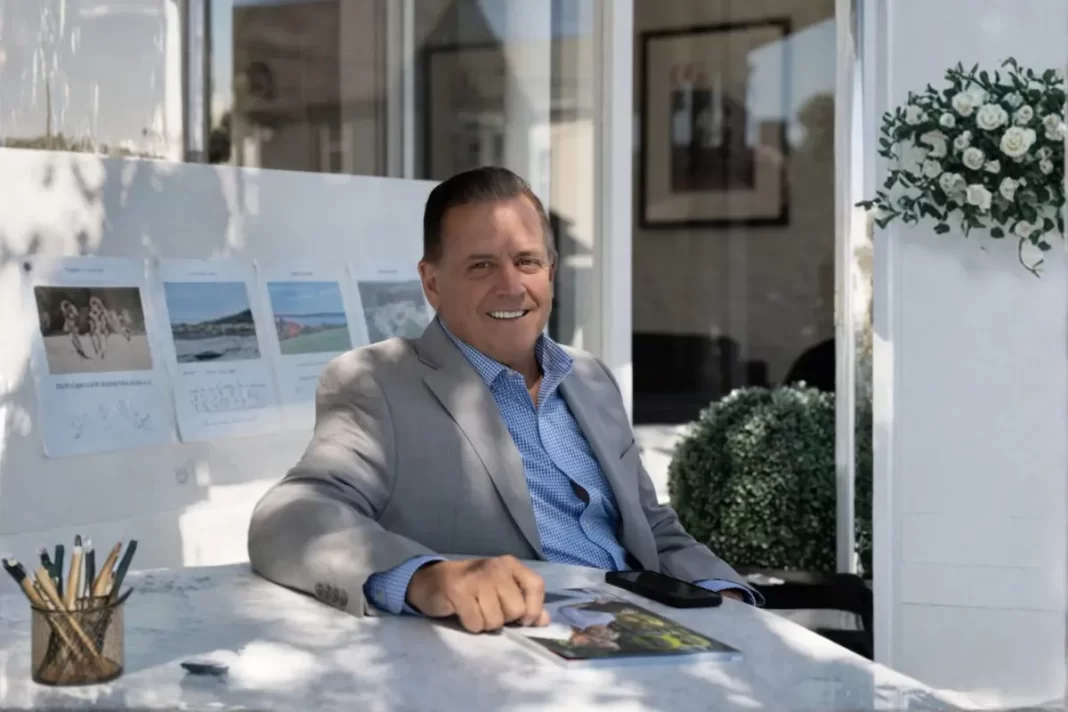
Rhode Island’s real estate market faces a mix of low inventory, changing buyer expectations, and increased competition. For agents starting or growing their careers in this environment, success depends on local knowledge, adaptability, and a willingness to approach problems creatively. Walt Buteau, a real estate advisor with Engel & Völkers Oceanside, entered the field full-time in 2024 after a long career in investigative journalism, bringing a skill set shaped by years of research, analysis, and public service.
A Deliberate Shift From Journalism to Real Estate
Buteau’s move from reporting to real estate was years in the making. “I’ve always been interested in real estate, but it was sort of a safety net,” he says. While working as an investigative reporter, he kept his real estate license active and sold about 100 properties over a decade, balancing both careers in Rhode Island and Florida.
His experience as a journalist often overlapped with his real estate work. “A lot of times the real estate knowledge helped me in journalism. I did a lot of work on various schemes involving real estate, whether it was bad Realtors ripping people off or stolen title cases,” he explains.
After returning to Rhode Island from Florida, where the market and lifestyle didn’t fit his family, Buteau decided to focus on real estate full-time. “I always planned on going full time into real estate, and because of the move back to Rhode Island, it seemed like a good opportunity,” he says.
However, the timing posed difficulties. “To be honest, it’s probably the most difficult year to start full time,” Buteau admits. “Inventories are down in many places, interest rates are up, so it requires a little more work than normal.”
Transferable Skills: From Investigations to Transactions
Buteau sees clear parallels between journalism and real estate. Both fields demand persistence in the face of rejection and require strong communication skills. “There’s a lot of calls required to get one news story or one source on the record, and there’s a lot of calls and interaction required to get one house on the market or one buyer to find the right house,” he says.
He emphasizes the need for people skills. “Both businesses involve really good people skills and being able to walk into a room and be open to talk to anybody,” Buteau says. “Both have a big impact on lives, whether it’s helping someone buy their first house or telling a story that matters.”
Rhode Island’s Inventory Problem: Local Causes, National Trends
Inventory remains Rhode Island’s biggest constraint. The state averages about 2,200 properties on the market at any given time, with 1,300 single-family homes. From October to October, inventory fell 10–15%. Buteau attributes this to the mortgage rate lock-in effect, with about 20% of homeowners nationwide holding mortgages under 4%. “That’s going to stop some people from selling,” he says.
Beyond interest rates, Buteau points to baby boomers with significant equity and no mortgage who hesitate to sell unless they can secure a suitable replacement. “I have multiple sellers who say, ‘I don’t want to list my house until I know I have a place to go,’” he notes.
This situation creates a chain reaction. “Once one of those blocks starts to move and decides to sell, then I think we’ll see inventory come back on,” Buteau explains.
Investor Competition Tightens Margins
Despite the tight market, investment activity continues. “There’s still people flipping,” Buteau says, noting he has a flip closing soon and completed others earlier in the year. However, he sees increased competition driving up acquisition costs. “The margins are a little tight on flips because the right price has gone up. Those people have more buyers coming to them saying, ‘I’ll give you $250,000, I’ll give you $265,000, I’ll give you $270,000,’ so now the margin between what you buy it for and what you can sell it for has tightened.”
Buteau cautions investors to be careful. “You’ve got to be really careful on the purchase side. It’s a game of musical chairs, and when the music stops, you could be stuck with a house you can’t sell.”
First-Time Buyers: Adapting to a Competitive Landscape
First-time buyers in Rhode Island face stiff competition, especially for move-in-ready homes. “A lot of first-time homebuyers want a house that is perfect and ready to move into and doesn’t need a lot of work. Everybody wants that. So those houses go quick and it’s competitive,” Buteau explains.
He encourages buyers to adjust their strategy. “I always tell my buyers to flip the search upside down. Let’s look at the houses that have been on the market for 30 or 40 days. Let’s not focus on the houses that just came on the market.”
Buteau also advises considering homes that need renovation. “I’ve helped multiple buyers through the process of fixing up their house, either getting them contractors or even lending them tools. Two people in particular bought houses that were in terrible condition, both very happy right now because they got them for really good money.”
He urges first-time buyers to look at condos and small multi-family properties. “First-time homebuyers should be open to condos. They should also be open to smaller multi-families,” he says, pointing to a current two-unit property listed at $400,000 as a strong entry-level investment.
Regional Differences Within Rhode Island
Not all Rhode Island markets behave the same. The East Bay towns of Warren, Bristol, and Barrington, with waterfront locations, remain highly competitive. “Those towns are popular because they’re on the water. In those three towns, I think there are 40–50 listings at most,” Buteau says.
He sees overlooked value in places like Woonsocket and Pawtucket. “Lifelong Rhode Islanders will go, ‘I would never live there.’ But I think it’s a good town, in a great location,” he says of Woonsocket. “Both communities are working on their school systems and have good locations, especially for people who work in Boston or northern Rhode Island.”
Luxury Market: Equity-Fueled Moves
Rhode Island’s luxury market remains active, driven by long-term equity gains. “People enjoyed their real estate going up. They might have paid $200,000–$300,000 six or seven years ago. Now it could be worth a million if they bought it right. So suddenly they have $700,000 in equity,” Buteau explains.
This equity enables owners to upgrade. “Now they’re saying, ‘let’s leverage that $700,000 plus some more and buy a $1.5, $2, or $3 million house.’ It sort of fed on itself,” he says.
Price Outlook and Policy Concerns
Some predict Rhode Island’s median sale price could hit $600,000 by 2027, but Buteau is skeptical. With the current median around $512,000, a 20% increase seems unlikely. “In that segment of $490,000 to $530,000 houses, I think they’re staying on the market longer and coming down a bit,” he says.
The state’s new “Taylor Swift tax” on luxury properties over $1 million owned by non-residents aims to fund housing initiatives, but Buteau questions its effectiveness. “I don’t like when the government reaches into our pockets and says we’re going to use this money for something else, because it’s never tracked very well,” he says.
Navigating a Changing Market
Despite headwinds, Buteau remains proactive. “I work every day trying to get people to sell,” he says. He focuses on educating sellers about current opportunities: “Now is the time to get top dollar for your house, because prices are leveled in many communities and are starting to go down.”
The outlook for Rhode Island’s market will depend on interest rate trends, sellers’ willingness to list, and ongoing inventory constraints. For agents like Buteau, success relies on a mix of research, negotiation, and the ability to guide clients through complex decisions.
As conditions remain challenging, agents with deep local knowledge and adaptable skills will be best positioned to help clients achieve their goals. Buteau’s background in investigative journalism provides him with the persistence and analytical ability needed to navigate Rhode Island’s evolving real estate market.